

Annotation
One of the most important components of computer vision is Image annotation. Computer vision essentially means giving eyes to machines so that they can closely match human actions. For creating an efficient, smart computer vision system, it must be trained on quality training data. Development of this training data needs human intervention. Annotation literally means assigning metadata or label to a given data like image, audio, video etc. The process of annotation is carried out by annotators who are machine learning experts or computer vision scientists. So, image annotation is a human-powered act to label or annotate an image.
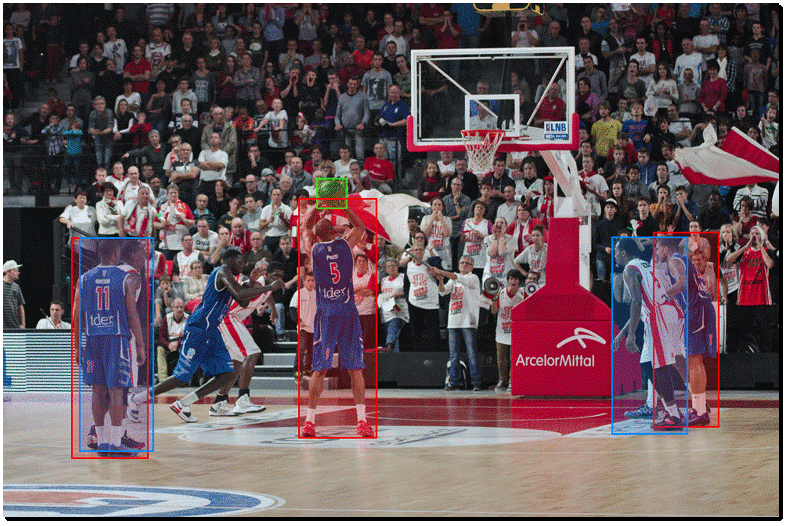
2D Bounding Box Annotation
2D Bounding box annotation is the most basic of all the image annotation techniques. 2D bounding box image annotation is used for training computer vision models on how to locate persons on images, individual objects, vehicles on roads. Our annotators draw bounding boxes over objects of interest in the images for your computer vision model. They ensure that there are no loose ends. Though the task seems simple, it requires meticulous efforts to maintain the consistency. We offer bounding box annotation services on the Client's Platform for various industries like robotics, self-driven vehicles, unmanned flying machines like drones, e-commerce & retail, agrotech and healthcare.

3D Bounding Boxes / Cuboids Annotation

3D bounding box annotation is also known as cuboids annotation. The only difference between the 2D and 3D bounding box image annotation techniques is that the cuboid annotation technique accounts for an additional dimension of depth/height other than length and breadth. Like 2D bounding box annotations, in cuboid annotation too, annotators draw boxes around the target objects by placing anchor points at the object's edges.
Our Global Crowdsource provides 3D bounding box annotation services with an unrivaled level of accuracy to acquire a 3D perception of the objects of interest. Use our cuboid annotation services to develop computer vision solutions for augmented reality, autonomous vehicles, robotics and recognition of 3D objects in both indoor and outdoor environments.
Polygons Image Annotation
2D and 3D bounding box image annotation techniques have a limitation, they cannot effectively annotate objects of irregular shape. So to make irregular or asymmetrical objects in images or videos recognizable for computer vision polygon annotation services are used. In this technique our annotator plot points on each vertex of the target object so that all of the object’s exact edges are annotated, irrespective of the shape of the object. Polygon annotation services are used in the annotation of road sign boards, human postures in sports or during exercise, logos, animals etc.

Semantic Segmentation

2D-3D Bounding boxes and polygons annotation services annotate individual objects in an image. However, to annotate each pixel in a given image, semantic segmentation annotation is used. Using semantic segmentation, pixel-wise annotation of objects in an image is possible. This helps in computer vision to localize the images with fine prediction. Semantic segmentation visualizes multiple objects of the same class as a single entity.
Unlike previous annotation techniques, in semantic segmentation, annotators divide a given image into a list of segment labels. For example - in semantic segmentation of traffic images for autonomous vehicles, annotators will segment the image by vehicles, bicycles, pedestrians, obstacles, signboards, roads etc. Also, a unique colour code is assigned to each segment.
Video Annotation using 2D and 3D Bounding Boxes
Our video tagging specialists use 2D bounding box & 3D cuboid annotation techniques to label objects in motion in a video. These labeled objects become the training data sets that enable your computer vision models to detect the object's depth, volume, and distance.
Text Annotation
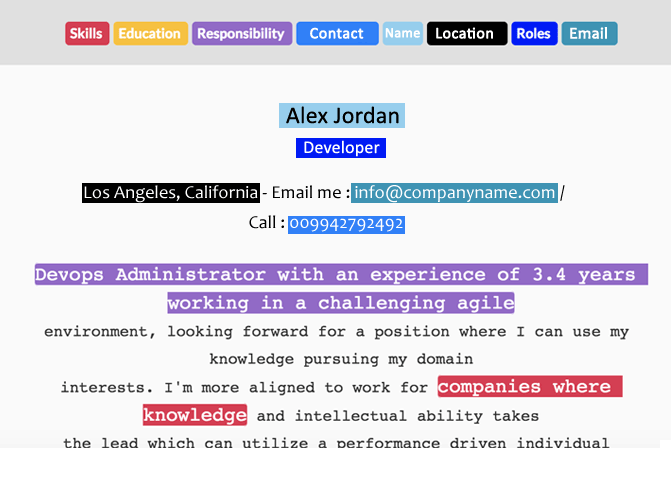
Text annotation is key to develop high-quality text training datasets. Labelling of linguistic elements like grammar, phonetics and semantics in the text or spoken form of language is known as linguistic annotation. Having experts from different languages and dialects, we have the capacity to handle projects of different languages at any scale.